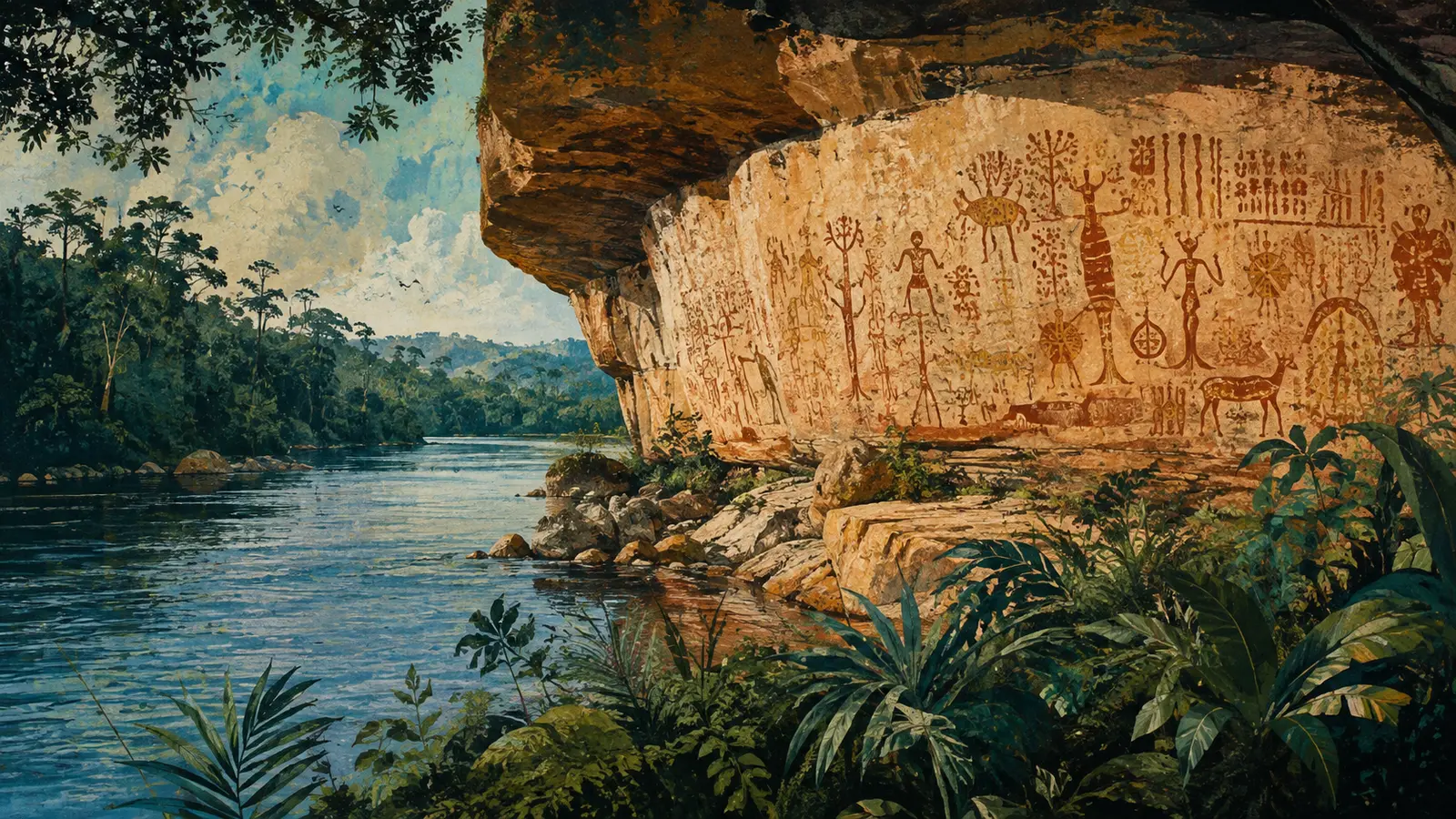
In Brazil’s far north-west, close to Colombia and Venezuela, rock paintings in the Alto Rio Negro region have been documented scientifically. The project brings together Indigenous communities, archaeology and environmental research.
Museu Goeldi stresses an important distinction: for the Baniwa and Koripako, these places were not suddenly discovered. They belong to oral history; what is new is the project’s scientific documentation.
That perspective is what makes the story compelling: archaeology can catalogue something for the first time without pretending nobody knew it before.
In brief
Rock paintings are pigments applied to stone, unlike rock engravings, where the surface is cut or removed. Two sites with paintings were documented in Alto Rio Negro.
Why it matters
The research calls the paintings new only from the perspective of western archaeology. For Baniwa and Koripako they belong to inherited history — an important distinction between documentation and supposed discovery.
A closer look
About 100 Indigenous and non-Indigenous participants from more than 20 institutions work in the Vozes da Amazônia Indígena project. The community decided to restrict access to the site to the research team for now.
More facts
The red and yellow pigments may contain ochre, and many surfaces are now covered with lichens. There is no firm date yet; early estimates broadly place them in the middle Holocene, 4,000 to 8,000 years ago.
How we know
This story is based on a publicly available original source.
Open the original source ↗