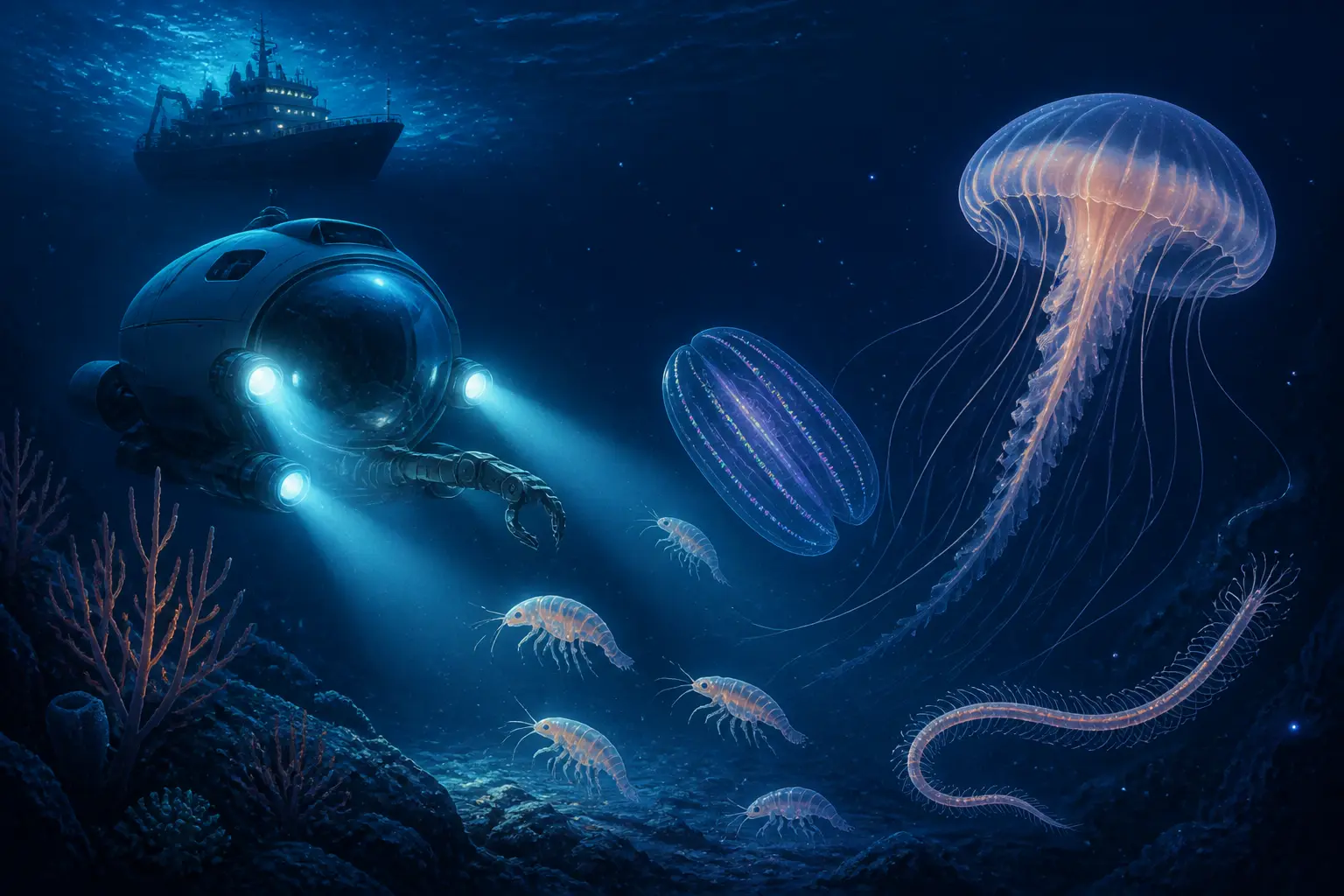
Two weeks aboard a research vessel, one remote stretch of the South Atlantic — and 31 animal species that, according to the expedition, had not yet been given scientific names.
The team worked in international waters off Brazil. Its finds included jellyfish and comb jellies, small amphipods and an exceptionally delicate bristle worm.
Researchers collected and documented the animals so specialists can formally describe them later. The number is therefore provisional, which is exactly what makes it remarkable: the deep sea still appears to hold a great deal that is unknown.
In brief
The team studied not the seafloor but the midwater: the enormous zone between the bright surface and the bottom. Many transparent, tiny and scarcely studied animals live there.
Why it matters
Thirty-one possible new species in two weeks is striking because the team could compare them on board using imaging systems, genetic analysis and specialist knowledge. Formal scientific descriptions come later.
A closer look
About two dozen researchers from the US, Australia, Brazil and Japan worked aboard the Falkor (too). A laser microscope nicknamed Squid revealed living cellular structures normally visible only after extensive lab work.
More facts
The finds include nine jellyfish, seven siphonophores and seven comb jellies. Midwater is considered Earth’s largest habitat, accounting for about 90% of its living space; many animals rise at night to feed and influence ocean carbon transport.
How we know
This story is based on a publicly available original source.
Open the original source ↗